You have written goals before.
Maybe on a napkin. Maybe in a journal. Maybe in a note on your phone that you open, read once, feel a small surge of hope – and then return to the same day you have always had.
And somewhere between the writing and the living, something dies.
Not the goal. The belief that you are actually capable of reaching it.
That is not a discipline problem. That is a design problem.
Most people are taught to want outcomes. Nobody teaches you how to engineer them. And so you carry this gap – between where you are and where you said you would be – like a quiet verdict on your character.
It is not. It is just the wrong method.
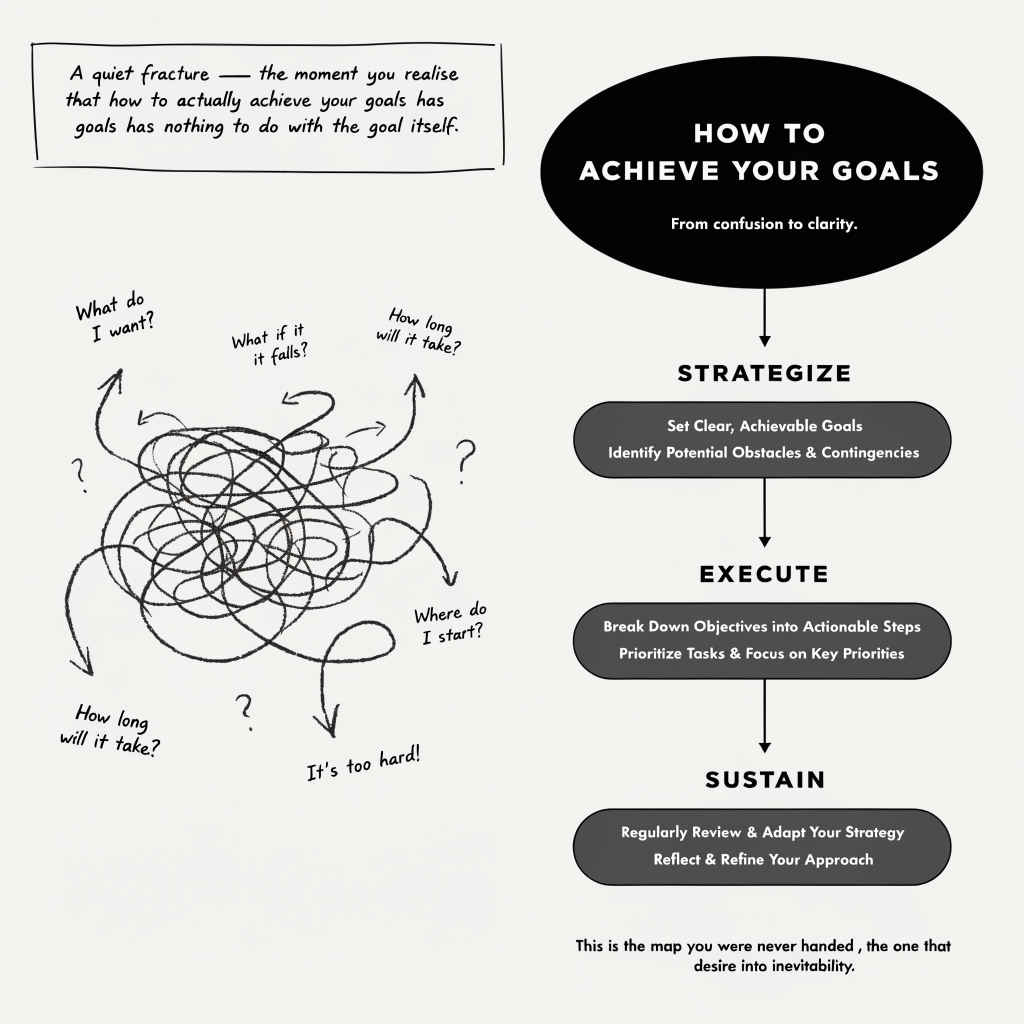
Here is what I know: how to actually achieve your goals has almost nothing to do with the goal itself.
The List That Lies to You
There is a version of goal-setting that feels productive but produces almost nothing.
You sit down. You write your desired outcomes. You read them aloud. You feel inspired for approximately forty-eight hours. Then the feeling evaporates – and the goal remains exactly where you left it: on paper.
This is not laziness. This is what happens when you mistake a destination for a direction.
Research on implementation intentions – the specific bridge between intention and action – shows that people who attach a concrete when, where, and how to a desired outcome are significantly more likely to follow through than those who simply commit to the goal. The goal alone is not the engine. The plan is.
But even the plan is only half the answer.
The deeper problem is what I call the desire gap – the space between a clearly named outcome and the daily inputs that produce it. Most people live inside that gap permanently. They know what they want. They do not know what to do today, tomorrow, and the day after to make it inevitable.
They are acting on the desire. Not on the inputs.
And acting on desire without inputs is hope without horsepower.
The Moment I Understood the Real Method
I used to believe goal-setting was broken. I had watched too many people write beautiful futures they never moved toward. I had done it myself. And the frustration was not just personal – it was philosophical.
If goals were supposed to be motivating, why were they so often demotivating?
Then I understood something that shifted everything.
A goal is not supposed to motivate you. A goal is supposed to inform you.
It is the starting point of a reverse-engineering process – not the destination you paste on a vision board and stare at. When you look at a desired outcome and ask, What would I have to do, believe, and become to make that inevitable? – the goal transforms from a wish into a working blueprint.
That is the fracture. That is where clarity begins.
This is the core principle woven through everything I have built inside Real Success Ecosystem: systems over fantasies. Inputs before outcomes. Identity before achievement.
Step One – Name the Result with Ruthless Precision
Most goal-statements are emotional. They sound like: I want to be successful. I want to be free. I want to be happy.
These are orientations, not destinations.
A real result is specific enough to measure, clear enough to visualise fully, and – critically – believable enough that you do not immediately disown it the moment you write it.
Research from the Dominican University of California found that people who write down specific goals are significantly more likely to achieve them than those who do not. But specific is the operative word. A goal like “increase my swing speed to 125 miles per hour” is a compass. “Get better at golf” is a feeling.
The specificity is not perfectionism. It is architecture.
And the believability is not positivity. It is permission. If you set a target that some part of you privately dismisses as impossible, you have already sabotaged the process. The mind will not pursue what the heart secretly rejects.
This is why in How to Not Be Numb I spent an entire section on reactivating belief as a precondition – not a byproduct – of achievement. You cannot feel your way to a goal you refuse to believe. You have to believe your way into the feeling first.
Name the result. Make it clear. Make it specific. Make it believable.
That is the foundation. Everything else is built on top of it.
Step Two – Evaluate the Inputs That Produce the Output
This is where most people never go.
After naming the result, the question is not how badly do you want it? The question is what perceptions, practices, and people will make it structurally inevitable?
Perceptions first.
Every outcome requires a belief system that makes it possible. Not inspiration – belief architecture. The person who earns ten times what you earn does not simply work harder. They hold fundamentally different assumptions about what is available to them and what they are capable of producing.
Neuroscience research on self-efficacy consistently shows that belief in one’s own capacity is one of the strongest predictors of performance – more reliable than raw talent, more durable than motivation. You have to audit the beliefs that currently govern your actions and deliberately replace the ones that cap your ceiling.
In Numbers of Destiny, I explore how deeply embedded self-concepts shape the trajectory of a life – often invisibly, often long before we are aware of them. The first work is always internal.
Install a new perception before you expect a new result.
Practices second.
A practice is not a task you complete. It is an action you iterate until it becomes identity.
Research on deliberate practice – the work of K. Anders Ericsson – demonstrates that mastery is not the result of talent but of structured, consistent repetition with intentional feedback loops. The people who make difficult things look easy have not transcended difficulty. They have accumulated enough iterations that difficulty transformed into fluency.
You want a result with seven iterations. That is not discipline – that is delusion.
The practice has to precede the performance, every single time.
And when you first begin, it will feel like regression before it feels like progress. Your body will protest. Your confidence will waver. The first days of any real discipline are always the hardest – not because you are failing but because disruption always follows intention. This is physiologically normal. Push through the first resistance. The other side is rhythm.
People third.
There is a version of your goal that already exists somewhere in the world. Someone is already living the outcome you are working toward. And the distance between you and them is not years of solitary labour – it is often one relationship you have not built yet.
No man is an island. No outcome is either.
The right mentor collapses timelines. The right community elevates your standards without you even trying. The right peer group makes your goal feel normal rather than exceptional – and that normalisation is a quiet form of permission to actually pursue it.
In The 7 Pillars of Love, I write about relationships as a form of architecture – structures that either support or silently undermine your becoming. This applies beyond romance. Every relationship in your life either raises or lowers the ceiling of your self-concept. Choose accordingly.
Perceptions. Practices. People.
These are your inputs. Evaluate them honestly. Install the ones that are missing.
Step Three – Act on the Inputs, Not on the Desire
Here is the final move – and the one almost nobody takes.
After you have named the result and evaluated the inputs, you act. Not on the goal – on the inputs.
This is the inversion most people never make.
Acting on the desire produces anxiety. Acting on the inputs produces results.
You do not control outcomes directly. You control the inputs that make outcomes structurally likely. When you understand this, the goal stops being a pressure and starts being a compass.
And your actions need three qualities to be effective.
Immediacy. When you identify an input that will move you forward, act on it as soon as you can give it your full attention and intention. Not permission – intention. The moment between insight and action is where most progress is lost.
Consistency. This is the one people resist most. Because consistency requires iterations before it delivers results. And in the space between the beginning and the breakthrough, it looks like nothing is working. It is. The compound is forming beneath the surface.
Studies on habit formation show that new behaviours take an average of 66 days – not 21 – to become automatic. Most people quit at day 12 because they cannot yet feel the change. The change is happening. Stay in.
Intensity. You have the capacity to escalate your effort. Use it. Consistent intensity is one of the hardest combinations to beat over time. Not occasional bursts – steady, applied force, directed at the right inputs, day after day.
This is what I call lines of demarcation – markers that tell you where you are and confirm that you are moving. Not just the destination. The milestones between here and there that make the journey measurable, motivating, and real.
In How to Keep Money, I apply this same framework to financial goals – because the same principles that govern physical transformation govern wealth accumulation. Name the number. Evaluate the inputs. Act on the inputs consistently, intensely, and with clarity. The mechanism is universal.
And in The JOB – Just Opportunities Building, I go deeper into how professional and financial goals are often blocked not by skill gaps but by identity gaps – the belief that the result belongs to someone else. It does not. It belongs to whoever does the inputs.
What This Requires of You First
Before any of this works, something deeper has to be true.
You have to be willing to express who you actually are inside the process.
Not the performance. Not the version of you that looks productive. The real version – the one with the actual desire, the actual fear, the actual gap between the wishful thinking and the daily truth.
This is the work I explore most personally in The Art of Self-Expression – because achievement that is disconnected from authentic identity is exhausting, unsustainable, and ultimately hollow. You can hit every milestone and feel nothing if you never anchored the goal to who you actually are and what you actually came here to build.
And in How to Have Peace, I deal with the psychological noise that sabotages goal execution – the inner chaos that makes even good systems feel impossible to maintain. Peace is not the reward at the end of the journey. It is the condition that makes the journey navigable.
The Prison That Was the Right Place
There is an old story about a man thrown into prison for a crime he did not commit.
He could have spent those years rehearsing his suffering. Instead, he developed his gifts in the dark, in the difficulty, in the place that felt entirely wrong – until the moment arrived that required someone who had been exactly where he had been, prepared exactly as he had been prepared.
The difficult place was the right place.
I am not saying your current constraints are comfortable. I am saying they may be precisely the conditions producing the person capable of achieving the goal you have written down.
The pain is not opposed to the plan. Sometimes the pain is part of it.
The Real Goal Method – Condensed
One result. Clearly named. Specifically defined. Personally believed.
Evaluated inputs – the perceptions, practices, and people that make the result structurally inevitable.
Action on the inputs – immediately, consistently, intensely – with lines of demarcation to measure real movement.
That is it.
Not a wish list. A steps list.
Not hope. A system.
Begin Now. Not When It Feels Right.
The full library of frameworks – across money, identity, relationships, purpose, and peace – lives inside the Real Success Ecosystem. Each book is a working tool, not a theory. Each one targets a specific gap between where you are and where your inputs could take you.
You can access the digital editions instantly at The Knowledge Shelf – or order physical copies from Lulu and Amazon if you prefer to hold your clarity in your hands.
The reading does not change you. The doing does.
But clarity precedes action. Every time.
Start with the result. Evaluate the inputs. Act on them – not someday. Now.
The goal is already waiting. The inputs are the only path there.
Who are you?
— Randolphe