You told yourself you were fine.
And some part of you almost believed it.
You processed things. You moved on. You got better at keeping it together – so good, in fact, that keeping it together became the only thing you knew how to do.
But the jaw is still tight. The chest still has a density to it, something low and unmoving. The shoulders carry a weight that no amount of sleep repairs. And somewhere under the competence and the calm and the forward motion, there is a pressure you have learned to ignore because you had no other option.
That is not weakness. That is not damage.
That is your body doing precisely what it was designed to do: hold what the mind could not finish.
The Body Does Not Forget
There is a long tradition – across somatic psychology, neuroscience, and philosophical inquiry – that points toward the same uncomfortable truth: emotions are not events that happen in the mind and then disappear.
They are physical.
They happen in tissue. In breath. In the nervous system’s tone. In the way the body holds itself upright at three in the afternoon when nothing is wrong and everything still feels heavy.
Bessel van der Kolk’s foundational research demonstrated that traumatic and unresolved emotional experiences are encoded somatically – meaning the body carries what the mind believes it has released. Fear is not a memory. It is a posture. Anger is not a thought. It is a pressure in the jaw, a locked breath, a silence you keep because you learned, somewhere, that expressing it cost too much.
You have not failed to process your emotions.
You have processed them exactly as far as language and understanding can reach – which, it turns out, is not far enough.
Five Zones. Five Emotions. One Map.
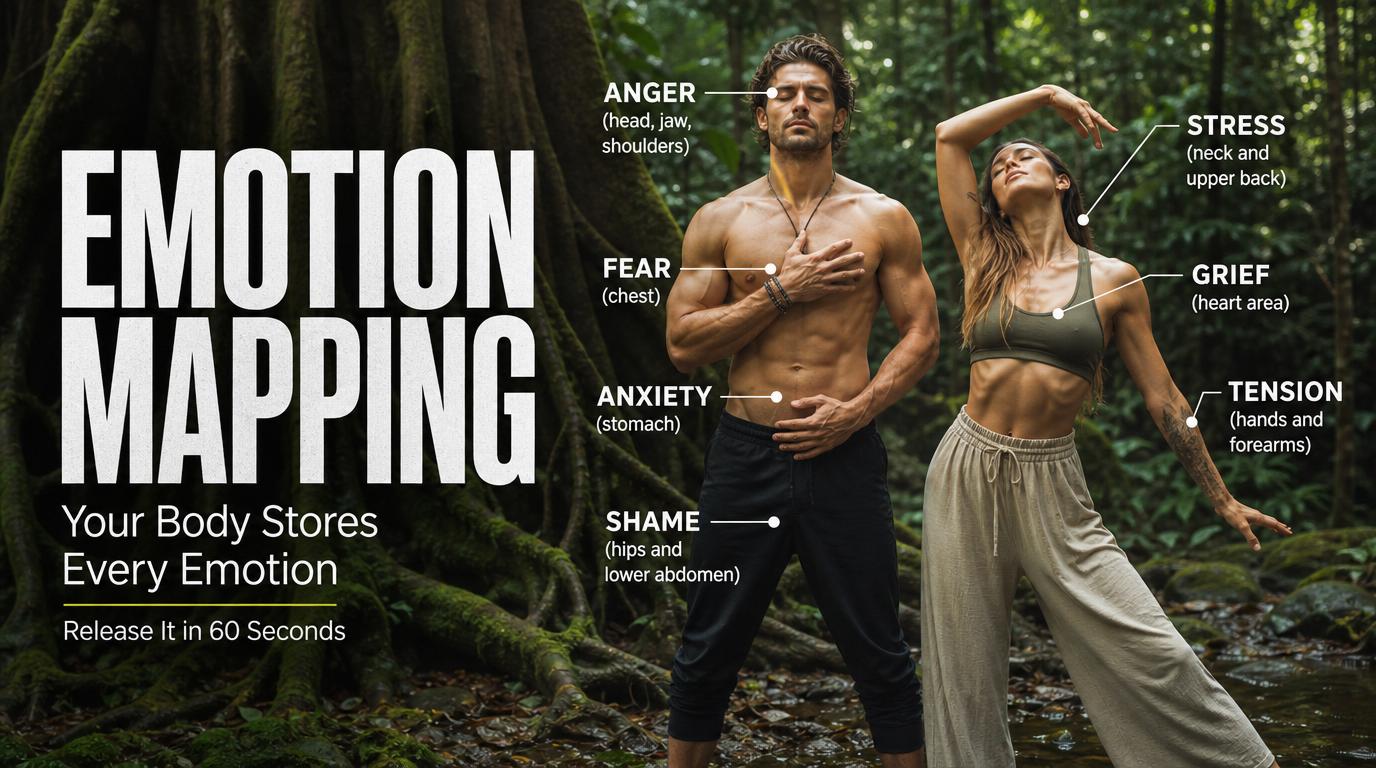
The science of emotion mapping works from a simple and devastating premise: every major emotional state has a predictable address in the body.
Not metaphorically. Literally.
A landmark study from the University of Aalto, conducted across five cultures, mapped bodily sensations corresponding to 14 emotional states. The patterns were consistent regardless of language, background, or belief system. Fear activated the chest and throat. Anger radiated upward – jaw, neck, hands. Sadness dimmed the limbs. Shame folded inward, contracting the chest and face. Anxiety scattered across the stomach and shoulders.
Your body has been following this map your entire life.
You just were never handed the key.
Zone One: The Chest – Where Fear Lives
The chest is the first to go quiet when danger, real or remembered, enters the room. It does not matter whether the threat is a predator or a conversation you have been avoiding for six months. The body responds identically – breath shallows, the sternum tightens, and the natural rise and fall of the ribcage becomes managed, controlled, careful.
Years of that pattern leave a residue. The chest that never fully opened.
Zone Two: The Jaw – Where Anger Waits
Anger you never expressed did not dissolve. It migrated. Into the jaw. Into the grinding that happens at night. Into the bite you hold when you want to say something and choose silence because silence is easier, or safer, or the thing that has always kept the peace.
The jaw carries decades of unspoken things.
Zone Three: The Stomach – Where Anxiety Settles
The gut is the body’s second brain – a fact established clearly in enteric neuroscience. The stomach does not just respond to food. It responds to everything. To the email you have not opened. To the conversation that went wrong last month. To the chronic low-level sense that something is about to shift, and you do not know if it will be good.
Anxiety lives here. Not as thought. As sensation.
Zone Four: The Shoulders – Where Responsibility Compresses
The shoulders carry what the mind has agreed to hold on behalf of others. Every obligation, every unprocessed expectation, every weight taken on quietly because that is simply what you do – it lives here. Not as metaphor. As muscular bracing, as a posture that never fully releases, as the part of you that forgets to put things down.
Zone Five: The Throat – Where Truth Goes Unexpressed
Polyvagal theory points to the throat and vagus nerve as central regulators of emotional expression. When something remains unspoken – the thing you know but have not said, the truth you have swallowed for years – it takes up residence here. The constriction. The tightness. The voice that becomes careful when it wants to be clear.
Why Understanding It Is Never Enough
Here is the fracture moment.
At some point, you understood your pain perfectly. You could name it, trace it, explain it to a therapist, a friend, a journal. You had theory. You had insight. You had a language for precisely what had happened and why it continued to affect you.
And it helped. To a degree.
But the jaw was still tight in the morning.
Because understanding happens in the prefrontal cortex. And the body does not live there.
Research on somatic therapies consistently shows that verbal processing alone does not reach the subcortical structures where emotional memory is held. You can understand your fear completely and still feel it in your chest at two in the morning. The gap between knowing and releasing is not a failure of intelligence. It is a failure of method.
The method has to go where the emotion actually lives.
The 60-Second Entry Point
This is where the practice of emotion mapping becomes something other than theory.
The Emotion Mapping guide – built across five targeted PDF practices – operates on a single premise: precision before release. You do not begin with breathwork. You do not begin with movement. You begin by going to the exact address.
Fear in the chest is accessed differently than anger in the jaw. Shame folded into the solar plexus requires a different release sequence than anxiety scattered across the shoulders and stomach.
The method integrates three entry points:
Targeted tapping – borrowed from the evidence base behind Emotional Freedom Techniques – reaches what words never reach. It interrupts the body’s threat signal at the somatic level, not the conceptual one.
Breathwork – not generically, but directed to the zone – unlocks what tension has been guarding. The chest that has been shallow for years does not open through understanding. It opens through breath that reaches it.
Somatic movement – small, deliberate, zone-specific – physically releases what has been stored. Not as catharsis. As completion. The body completing what it began years ago and was interrupted before it could finish.
What Carrying It Has Cost You
The most dangerous thing about unprocessed emotion is not the feeling itself.
It is the compensation.
The mind builds around unresolved body-states. Avoidance patterns, hypervigilance, the chronic low-grade fatigue that is not depression and is not tiredness but is something in between – these are not character flaws. They are adaptations. Intelligent ones. Your system found ways to keep functioning despite carrying weight it was never meant to hold permanently.
The work of emotion mapping is not dramatic. It does not require you to revisit everything or collapse into what you have been managing.
It requires you to go to one zone. Breathe into it. Tap it. Move it. Sixty seconds.
And then to notice what shifts.
The Books That Hold What the Body Releases
Emotional release without direction creates space. But space, on its own, has no shape.
The body work opens the room. The question is what you build inside it.
This is where written inquiry becomes a second instrument. How to Have Peace is not a philosophy book in the decorative sense. It is a structural examination of what peace actually requires – not the absence of noise, but the presence of something anchored enough to hold when the noise returns. When the chest finally opens, the question follows immediately: what fills it now?
How to Not Be Numb addresses what happens after years of managed suppression – the quiet erasure of feeling that passes as stability. Numbness is not the opposite of pain. It is pain’s most disciplined response. The book examines how to return without flood.
For those who have learned, somewhere, that self-expression carries risk: The Art of Self-Expression is a long conversation about the difference between performance and voice. Between what you project and what you actually are.
The 7 Pillars of Love enters territory that somatic work always eventually reveals: that most of what the body has been holding is relational. Stored in the spaces between people. In what was given and what was withheld, what was asked for and what was never said.
And In Search of the Righteous Man asks the identity question that physical release always surfaces: once you are no longer defined by what you carry – who are you?
These are not supplements to the body work. They are the continuation of it, at a different frequency.
The PDF Guides and What Each One Reaches
The Emotion Mapping bundle contains five primary practices, each targeting a different zone.
The Discharge – available here – works directly on stored tension through two breathing techniques that shift the nervous system from reactive to regulated. Not as a concept. In real time.
The Quiet – available here – addresses the racing mind not as a thought problem but as a body signal. The overthinking is a symptom. The guide works on the source.
The Unfreeze – available here – goes directly to the chest and the frozen quality that fear leaves behind. Not metaphorically frozen. Literally contracted. This guide goes there.
The Uncage – available here – works on the jaw, the hands, the throat. Anger that became silence and then became people-pleasing and then became a personality. This guide is the reversal.
The Return – available here – addresses what lives in the chest and stomach as the inner critic. Not through affirmation. Through release. What you say to yourself when no one is listening changes when the body beneath it shifts.
The bonus guide, The Reset – available here – integrates everything through spinal movement and conscious breath. The body that has released needs to be settled, not left open. This is the closing of the loop.
What Happens After
The change is not theatrical.
You do not collapse. You do not have a revelation. You do not emerge transformed in the way performance requires.
What happens is quieter and more permanent than that.
The jaw unclenches. Not because you decided to relax – but because the pressure that was held there has nowhere left to be. The chest breathes to its full depth for the first time in something that might be years. The shoulders, without drama, put something down.
And in that space, something you had forgotten becomes available again: the version of you that existed before you learned to manage everything. Not naive. Not unguarded. Just – present.
The work of Real Success Ecosystem is built on a belief that has survived every test: real change is not installed from the outside. It is already inside you, waiting for the obstruction to move. The emotion mapping practice is not the destination. It is the clearing.
What you build in the clearing – that is the real work.
The Invitation
You do not need to understand this more than you already do.
You have been carrying something in your body that is not yours to keep forever. You felt it while reading this. In the chest, in the jaw, somewhere specific that you recognized before the sentence was finished.
That recognition is the beginning.
The Emotion Mapping guide – five practices, sixty seconds each, one dollar – does not ask you to change your life or your beliefs or your schedule.
It asks you to go to the address. Breathe into it. Let it move.
The rest becomes inevitable from there.
Who are you?
– Randolphe