There is a question you have been carrying that no one around you has been brave enough to ask aloud.
Not who to marry. That is the surface question. The real question – the one burning quietly underneath it – is this:
What kind of civilization am I building, and does the woman I choose have the cultural wiring to help me build it?
Most men choose a partner the way they choose a restaurant. Based on what is nearby. Based on what looks good from the outside. Based on what feels familiar and safe and easy.
And then they spend decades trying to build something lasting with someone whose foundation was poured in entirely the wrong culture.
I am not here to tell you what to feel. I am here to tell you what I have seen – across five continents, twenty-three countries, and cultures that have been transmitting their values for thousands of years while the Western world was busy dismantling everything that once made a family last.
This is not sentiment. This is architecture.
You Are Not Looking for a Girlfriend
A loyal wife who builds your legacy is not something you find by accident. She is something you choose, deliberately, from within a culture that already built her for exactly what you need before you ever arrived.
This distinction changes everything.
Attraction is temporary. Chemistry is weather. But culture? Culture is the operating system she runs on. Culture determines what she does when no one is watching, what she teaches your children when you are not in the room, and what she sacrifices without being asked to sacrifice it.
The three questions that override every country, every city, every individual woman are these:
Does her culture honor the father’s role? If no – walk away. The culture is the last line of defense when individual character fails.
Does she have a moral code that existed before she met you? A woman whose values were formed by her faith, her family, her people – before she ever knew your name – is a woman whose values will survive the moments when you are not watching.
Does she want to build something, or consume something? This distinction becomes visible within six months. Watch what she does with her time when nothing is demanded of her.
These three filters are not romantic. They are architectural. And if you have never had a framework for understanding love at this depth – not as emotion, but as a living structure that either builds or dismantles the people inside it – then the work that must happen before this search is the inner work. In The 7 Pillars of Love: A Journey to the Heart of Connection, Meaning, and Fulfillment, I mapped exactly this – what love actually is at its foundation, why most men experience its absence without ever naming what is missing, and how the seven pillars of genuine connection create the conditions for a relationship that transmits meaning to the next generation rather than consuming it. If you want the physical edition, the paperback is available here. Read it before you travel. Understand what you are building before you begin to build it.
Pew Research Center’s global studies on what makes life meaningful across seventeen advanced economies confirm that family and children consistently rank as the primary source of meaning in the regions most likely to produce the woman you are looking for. That is not sentiment. That is a data pattern that reflects thousands of years of cultural prioritization.
The Continent That Starts Closest to Home
If you are on the African continent, the answer to where to begin is not across an ocean. It is across a border – or perhaps simply in the next country.
Africa holds the deepest and most uneroced version of what you are looking for. Because in many of its cultures, the traditional understanding of marriage was never fully dismantled. It simply evolved – slowly, carefully, with elders still at the center of every negotiation and every covenant.
Cameroon – Where the Dot Still Means Everything
Cameroon is the most underrated country on this continent for the mission you are on. Bilingual – French and English. Deeply Christian in the majority. Educated in its university cities of Buea, Yaoundé, and Bamenda. And operating under a culture where the traditional marriage ceremony – the dot – is not a relic. It is living law.
As of December 2024, Law No. 2024/016 gave customary marriage full legal equivalence to civil marriage in Cameroon. The bride price ceremony now carries the same legal weight as a court registration. But the cultural weight was never in question.
At a Cameroonian ceremony, the bride and groom are publicly asked – in front of both families – which type of marriage they are choosing: monogamous or polygamous. They are asked whether they will combine finances or keep them separate. The man is declared head of the family. Not suggested. Declared.
The knock door process comes first – the groom’s family, led by a spokesman uncle, visits the bride’s family home with kola nuts, palm wine, goats, fabric, palm oil, farming tools, and firewood. The family heads – not the parents – conduct the first negotiation. Two spokesmen represent the two families in formal dialogue. The couple is secondary to the covenant being constructed around them.
This is a woman who has watched her own mother be married this way. Who watched the elders negotiate. Who understands that marriage is not a feeling – it is a formal joining of two civilizations.
Ethiopia – The Oldest Civilization’s Deepest Loyalty
Ethiopia does not produce wives. It produces women who were already raised to be mothers before you ever arrived.
The Shimagelay process – where respected community elders from the groom’s side formally visit the bride’s family as a diplomatic delegation – is not theater. It is a cultural intelligence test. It asks: does this man come from people worth joining? Does his character precede him?
Both families conduct background investigations before a single yes is spoken. They research reputation, lineage, and character. If concerns arise, the elders advise the couple. Family approval is not a hurdle. It is the architecture of permanence.
At the wedding itself, the couple is dressed in royal apparel – the bride in her Habesha kemis, both wearing crowns – and they enter the reception as king and queen. After the celebration, elders counsel the newlyweds one by one. Each speaker concludes with gifts. The community invests in the marriage’s success from the moment it begins.
Children born to a foreign father and an Ethiopian mother follow the father’s nationality under Ethiopian law. Your legacy is legally protected from the moment the certificate is signed.
Go to Gondar. Go to Hawassa. The women you find there carry the quiet certainty of a culture that has been continuous for three thousand years.
Ghana, Kenya, Rwanda – The English-Speaking Tier
Ghana is English-speaking, Christian-majority, politically stable – and the Opon-akyi bo ceremony (Knocking on the Door) is still the required gate. The groom’s family arrives with kola nuts and palm wine. The bride is brought into the room in front of both families and asked, publicly, whether she consents. Without her yes, the process stops. This is not performance. This is contract.
Kenya’s 2014 Marriage Act formalized what the culture had always practiced – a man may take multiple wives under customary law. The Ruracio ceremony places the covenant in the hands of grandparents, parents, uncles, siblings, and in some traditions the ancestral spirits themselves. Marriage in Kenya is witnessed by the living and the departed. That weight makes it real.
Rwanda is what discipline looks like in a country that rebuilt itself. The Gusaba ceremony – where the groom’s family delegation arrives with banana beer and sorghum to formally request her hand through a conversation between elders – reflects a people who take the beginning of things seriously. The beginning is where everything is decided.
Cross-cultural research published in peer-reviewed anthropological journals consistently demonstrates that marriages embedded in structured family approval processes show significantly higher long-term stability than those formed on individual romantic attraction alone. The data confirms what the cultures already knew.
The East That Never Forgot What Family Means
The Philippines – The Global Standard for Loyal Motherhood
There is a reason the Philippines sits at the top of every serious ranking of countries that produce devoted mothers and loyal wives. It is not beauty. Beauty is everywhere. It is the cultural infrastructure built over centuries of Catholic devotion and communal family life.
The Philippines has no divorce law. Marriage there is not a contract with an exit clause. It is a covenant – entered into by a woman who understands from the beginning that she is not testing this man. She chose him. Permanently.
The Pamamanhikan – the formal family visit where the man and his entire family present themselves at the woman’s parents’ home to ask for her hand – is the most important day before the wedding. How you conduct yourself in that room is how the family will judge your character for the rest of your life. The visit is the audition. Pass it with grace and seriousness.
The Kasalan wedding includes the Arrhae coins – thirteen gold pieces given by the groom, representing his commitment to provide. The cord ceremony binds the couple with a floral cord. The candle and veil ritual seals the blessing. The money dance (Sayaw sa Pera) invites the community to publicly invest in the new family’s abundance.
UNICEF data on family environment and child welfare across Southeast Asia consistently places Filipino family cohesion among the highest on the continent. Children are not an addition to the Filipino woman’s life. They are the point.
Go to Cebu. Go to Davao. Go to Iloilo. The woman you find there will raise your children with the gravity of someone who has always understood that motherhood is not a role. It is a calling.
Japan, Vietnam, and Indonesia – Discipline, Devotion, and Depth
Japan produces the highest child investment culture on earth. The San-san-kudo – the ritual sipping of sake three times from three cups during the Shinto ceremony – seals the marriage in layers. Her commitment was not impulsive. It was deliberate. She has been prepared for the gravity of this choice her entire life.
Vietnam’s Lễ Hỏi engagement ceremony – where the groom’s family arrives with lacquered boxes of betel leaves, wine, areca nuts, and fruit – is a formal request for two family lineages to merge. The ancestor altar is present at every Vietnamese wedding. The lineage is always in the room. You are not just marrying her. You are joining a chain of people who came before her.
The Fire That Raises Warriors
Colombia is where passion and structure coexist in a way that almost nowhere else can replicate.
Go inland – to Pereira, Manizales, Bucaramanga – and you find the version of Colombian womanhood that the coastal cities have been diluting for two decades. Go where the Catholic backbone is still the operating system of daily life.
The Pedida de mano requires the man to arrive at her father’s house – with his family, with gifts – and ask permission to marry her face to face. Not a message. Not a phone call. A physical, respectful, deliberate demonstration of intention. Her father’s yes is the gate that opens everything. Her mother’s approval is the seal.
The Lazo – a floral cord placed in a figure-eight around the couple – and the Arras – thirteen gold coins given from the groom to the bride – are not decorative. They are statements of architecture. He commits materially. She receives that commitment as a covenant.
The celebration does not end until the father of the bride signals the end. Often at 6 AM the following morning. This is not a party. This is a family’s public declaration of joy that a new civilization has begun.
A Colombian mother does not raise soft children. She raises warriors with warmth. That combination is rarer than it sounds, and more powerful than any degree, business strategy, or investment return you will ever encounter.
The Discipline Continent
Eastern Europe does not receive enough credit in this conversation.
The women of Poland, Ukraine, and Serbia are among the most disciplined mothers on earth – not because discipline was imposed on them, but because it was transmitted to them through cultures that never stopped treating family as the primary unit of civilization.
The Polish Oczepiny – the midnight ceremony where the bride’s veil is replaced with a married woman’s headscarf – is a visible, communal transition. She is not just changing her status. She is entering a different phase of identity, witnessed by everyone who matters. The second-day celebration, Poprawiny, is where the real family bonding happens after the formal ceremony is complete.
Ukraine’s Korovai bread – baked only by happily married women from the community, decorated with dough sculptures of birds, wheat, and suns, carrying their collective blessing into the loaves – is one of the most sophisticated cultural artifacts of marital intention I have ever encountered. The people who bake the bread are the culture’s statement about what kind of energy should surround the new family.
The Rushnyk – an embroidered cloth woven by the bride’s mother, sometimes for months – is placed under the couple’s feet and used to bind their hands during the ceremony. It is an heirloom. A mother’s blessing, woven thread by thread into fabric, given to the new family as their foundation.
Peer-reviewed research on family cohesion and child development outcomes consistently confirms that children raised in high family-cohesion environments demonstrate greater emotional regulation, stronger identity formation, and higher relational stability in their own adult lives. The culture transmits itself through the mother. Choose the mother carefully.
What the Culture Demands of You First
Before any of this applies to you, there is a truth you must sit with.
Every culture on this map – from the dot ceremony in Cameroon to the Shimagelay in Ethiopia, from the Pamamanhikan in the Philippines to the Svaty in Ukraine, from the Pedida de mano in Colombia to the Korovai in Poland – begins with the same demand.
It demands that you show up with a character that precedes you.
You cannot buy cultural respect with a bride price if you have not first built a life that the elders can look at and say: this man has something worth joining. The families are not just evaluating your money. They are evaluating your lineage. Your discipline. Your trajectory. The man your mission is making you into.
Behavioral research on partner selection and long-term outcomes confirms that values alignment between partners is among the highest-leverage variables in generational stability and wealth-building. You cannot select for values you have not yet developed in yourself.
This is the work that happens first. Before the flight. Before the research. Before the ceremony.
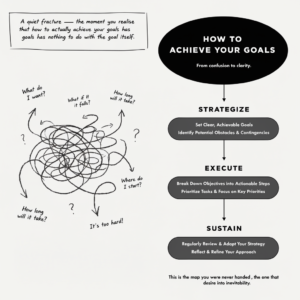
The Real Success Ecosystem exists precisely in this space – between knowing what you want and becoming the man who is ready to receive it. Not as a platform, but as an environment where clarity compounds until inevitability replaces effort.
The Choice You Are Really Making
You now have what most men never get.
Five continents. Twenty-three countries. The cultural codes, the traditional ceremonies, the legal frameworks, the polygamy laws by jurisdiction, the bride price customs, the elder protocols, the exact steps from the first knock on the door to the certificate that makes it permanent.
But a map without movement is just paper.
Research on cross-cultural marriage and identity formation shows that the decision of whom to marry – and from which cultural context – is among the most consequential identity choices a man makes. Not because of what it does to him emotionally. Because of what it does to the generation that comes after him.
The right woman is not somewhere you have not looked. She is inside the culture that was already shaping her – for years, maybe decades – to carry the values you are trying to build your life around.
She is in Buea. She is in Gondar. She is in Cebu. She is in Pereira. She is in Kraków.
She has already been prepared. The question is whether you have been preparing yourself to deserve her – and to lead what comes after she says yes.
Understanding love as a structure – not as a feeling – is the beginning of that preparation. The seven pillars explored in The 7 Pillars of Love are not abstract concepts. They are the load-bearing walls of everything you are trying to build with another human being. A relationship without them does not fail loudly. It erodes quietly, in the spaces between what was promised and what was actually practiced. Get the paperback edition and keep it close.
Begin with who you are becoming. The dynasty follows from there.
If this article opened something in you that you have been unable to name, the next step is the inner architecture: The 7 Pillars of Love (PDF) · Paperback Edition · And the environment where the man who deserves that woman is built: Real Success Ecosystem
Who are you?
– Randolphe